
Bujinkan Budo Taijutsu Course
“Perfecting Your Bujinkan Budo Taijutsu” – ten master instructors share the most important Bujinkan budo principles. This can also be a certification course.
Perfecting Your Bujinkan Budo Taijutsu
“Perfecting Your Bujinkan Budo Taijutsu” is exactly what this Budo Taijutsu Course should be called.
Face it, Budo Taijutsu is not easy to define as a martial art. Some people really get it and yet others struggle in learning it.
One reason is that it is hard to define – much less structure into a body of study. It is an art that needs to be interactively practiced with someone that is beyond your own current knowledge level. It is really a study of concepts, principles and ideas to use in combat. Like exploring the proper distance, controlling the space (kukan), taking your opponent off balance, striking without being seen, etc. (the course has over 100 principles). Even Soke Hatsumi does not teach a formal way but yet uniquely demonstrates his concepts and principles to any form. He demonstrates simple but yet complex relationships of budo.
Your Budo Taijutsu Course Contains
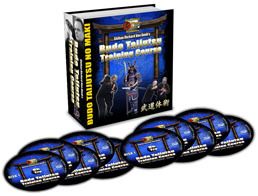
- 236-page “Perfecting Your Budo Taijutsu” instruction course manual, mailed and also online in PDFs
- 11 video Master Classes, 1 hour+ each: Doshi Richard Van Donk and 9 other instructors share their master concepts of Budo Taijutsu in demonstrations and drills to practice
- 70-page Ten Chi Jin manual: Doshi’s notes from 25 years of compiling and studying the Heaven, Earth and Man scrolls. Included in case you are not familiar with the core teachings of Soke Hatsumi
- View on computer, tablet or the dedicated phone app
The Most Important Lessons and Concepts
This course was created to help ALL Bujinkan Budo Taijutsu practitioners understand all the dynamic relationships of the Bujinkan art. This art has never been defined the way it is in this Bujinkan Budo Taijutsu Course. For many students it has been difficult to determine what they are really studying and what is important in that study. One reason is that the training draws from 9 different schools and overlaps in its concepts in every class. The other is that while concepts are explored they have not been defined all in one place leaving the student to determine for themselves what is useful in the training. This has its pros and its cons. Many students and instructors have become confused.
It will take literally years off your training curve.
What Are the Most Important Lessons of Budo Taijutsu?
Every year when I plan our annual Tai Kai event I choose a very special theme for the training. When I sat down to think about it I had this great brainstorm that lasted for several hours – I mean I literally could not stop writing for almost 3 hours!
My brainstorm was triggered by asking myself this question:
“What are all the most important lessons of Budo Taijutsu ever taught to me by Soke Hatsumi over the last 25+ years?”
This really is a great question to ask yourself at any time about the art you study. And when you have studied an art for over 30 years and have made over 50 trips to Japan to train with Soke Hatsumi and other Shihan this is a super question!
But I don’t want to get off track here – most important to me were all the answers I got to that question and the method by which I got them. They literally came flying into my brain and at first I wrote them down as bullet points – but then as I went back over the bullet points I received specific exercises on how to share these points with you.
Then I codified all the lessons into a progression of importance to detail it all out for anyone to learn them.
WOW! But I didn’t stop there. I then contacted my senior instructors and asked them to write out their 10 top most important insights on this question. From those answers I asked some of them to work a few months on a lesson plan and come share it at the event. Helping Doshi Richard Van Donk (15th Dan) share their master Budo Taijutsu principles in this course with their years of experience are Shihans Dan Ordoins (15th Dan), Linda Van Donk (13th Dan), James King (13th Dan), John Owsiak (8th Dan), Carlito Flores (8th Dan); Shidoshis Charles Benham (7th Dan), Roman Marquez (7th Dan), James Clum (7th Dan), and Shidoshi-hos Jamie Daiken (4th Dan) and Theodore Schink (4th Dan). These IBDA instructors have all trained with me (and others) and have been to Japan to train in the hombu dojo directly with Soke Hatsumi. You have to agree that this adds up to a wealth of experience in budo. Get the best of what they have learned in the arts presented to you. Get started and enjoy this training.
I filmed this event! And compiled their most important concepts of Budo into a 236 page manual that includes the Ten Chi Jin Shidoshi books that has my own training notes in it.
Doshi Richard Van Donk
Choose Your Course Option
Years of training. Averages just $10 a month. You get BOTH the physical course Binder manual mailed to you and the Online Dojo video and manual training in the Bushindo University portal, so you will always have the latest teachings for life.
Budo Taijutsu Course
- Online portal
- Video lessons
- Binder manual (mailed)
- Manual online PDFs
- Lesson comment + Q & A
- Free lifetime online updates
Budo Taijutsu Course with DVDs
- Online portal
- Video lessons
- Binder manual with DVDs
- Manual online PDFs
- Lesson comment + Q & A
- Free lifetime online updates
Need a payment plan? Use Afterpay or Klarna monthly pay options in the checkout cart at Bushindo University.
The Art of Distance
Budo Taijutsu is a practical natural real fighting and philosophical martial arts system deeply founded in the lore of the mystic warriors of feudal Japan, both the Samurai and the Ninja. In our dojos we practice techniques, wazas, principles and philosophies of 9 different Japanese martial art schools, known as Ryu in Japanese. We train both unarmed and armed (both ancient, exotic and modern). We train in true proven ancient budo methods and we train in modern applications that have been used by Special Forces, FBI, DEA and police forces worldwide.
Grandmaster Masaaki Hatsumi
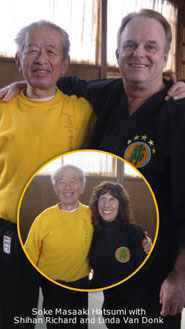
Grandmaster Masaaki Hatsumi (also known as Soke) is the founder and International Director of the Bujinkan Dojo with its Hombu Dojo, the Bujinden (Divine Palace), residing in Noda City, Chiba Prefecture, Japan and has an administration office attached to his downtown home. He is married to his lovely wife, Mariko, a famous Japanese dance teacher and 10th dan director of women’s training for the Bujinkan. Dr. Hatsumi is the inheritor of nine Ninjutsu traditions from the late O’Sensei Toshitsugu Takamatsu (the last true living Ninja) in the early 1970’s just before Soke Takamatsu’s passing in 1972. It is said that Dr. Hatsumi was the only one receiving in-depth training with the great Takamatsu during the last 15 years of his life.
Soke Hatsumi is the author of over a dozen books and 40+ DVDs on the art of Ninjutsu and Budo Taijutsu. He has been featured in almost every magazine relating to this subject in Japan, and throughout the entire world. He wrote, directed and acted in 50 episodes of a television series called ‘Jiraya’ which was the number one watched kid’s program in Japan. The collective teachings that he inherited from the late O’Sensei Toshitsugu Takamatsu are now referred to as Budo Taijutsu.
A Strategic, Step-by-Step Path to Master
At IBDA Doshi Richard J. Van Donk offers a strategic standardized step-by-step learning and ranking system. This special system has been refined for over 20 years by some 50 trips to train with Soke Hatsumi, his owning every piece of Soke’s printed material, several hundred published and non-published videos, personal training with Soke who answered all his questions, personal training with most all senior Japanese instructors, and instructing several thousand students to every level in the Bujinkan, including many students to high Judan levels with lots of them starting with the distant learning Ninjutsu BlackBelt course. Bottom line, our method works. The proof is in the students whose lives have been changed by our training. Yours will be too when you study with us.
Everyone who is affiliated with us will have studied this material or has proven to Doshi Richard Van Donk that they indeed know the material presented in our courses. There is no exception and there will be no exception. We believe in our standard and recommend that all teachers do the same. Ranks just given without meaning or the student knowing what they have learned for the rank they were given is in our opinion unfair to the student. We prefer the University approach. You can learn anything you want in any order you want with us. Do what you love and the rank will come as you learn and can demonstrate the required material as outlined very clearly in our Kyu and Dan ranking curriculum. All of our ranks have always been and always will come through Soke Hatsumi in Japan. And that is a rank you can be sure will be recognized worldwide.
Below is a short overview of what you learn at each level.
Ninpo Taijutsu Training – 9th Kyu to Shodan
Kyu grades: 9th Kyu (Kyukyu), 8th Kyu (Hachikyu), 7th Kyu (Nanakyu), 6th Kyu (Rokkyu), 5th Kyu (Gokyu), 4th Kyu (Yonkyu), 3rd Kyu (Sankyu), 2nd Kyu (Nikyu), 1st Kyu (Ikkyu). Shodan, 1st degree BlackBelt: at this beginning level you will learn an overview of all the 9 schools and their weapons to prepare you for the deeper study of Budo Taijutsu and all the 9 schools wazas and principles.
Shodan Level Training
Ninpo Taijutsu training from 9th kyu to Shodan you learn a strategic systematized overview of the Ninjutsu 9 schools including foundations, postures, punches, kicks, weapon basics, history, stealth, chokes, grappling, throws, meditation, proper body movement and much, much more. Hundreds and hundreds of techniques. On the average our students spend 3 years of solid training on this level as it covers main aspects of Togakure Ryu, Gyokko Ryu, Koto Ryu, Kukishinden Ryu, Shinden Fudo Ryu, Takagi Yoshin Ryu preparing you for a deeper focus of individual schools that you will study at succeeding dan levels. After learning a very solid overview of the nine traditions you will begin to explore the actual school (known as Ryu) material in a more in depth way by studying the deeper principles and partner exchange forms called waza. Unlike a Kata which is performed by oneself to perfection, wazas are interactive drills that are done with at least 2 persons both in a formal way and with many variations so that the principles of the school can also be learned. Wazas also help you learn timing, distancing, and eventually true budo protection methods.
Nidan Level Training
2nd degree Black Belt training includes Kosshijutsu study of the principles and Gyokko Ryu wazas of Jo Ryaku no maki, Churaku no maki and Geryaku/Mutodori gedan plus 24 Kukishinden Ryu Hanbojutsu, Shoden/Chuden/Okuden level wazas.
Sandan Level Training
3rd degree Black Belt training includes principles and wazas of Shinden Fudo Ryu Dakentaijutsu, Ten & Chi No Maki, Shizen Shikoku No Kata Jutaijutsu, Shoden Gata/Juroku Gata/Chuden/Okuden levels and from Kukishinden Ryu: Rokushakubojutsu – Shoden, Chuden, Okuden, Kuden levels.
Yondan Level Training
4th degree Black Belt training includes principles and wazas of Takagi Yoshin Jutaijutsu including Shoden No Kata/Chuden No Sabakigata/Chuden No Tai No Gata/Okuden No Kata levels and Eri Shimegata, Moguri levels. Kukishinden Ryu: Yari Jutsu, Kodachi, Muto Dori.
Godan Level Training
5th Degree Blackbelt training includes principles and wazas of Koto Ryu Koppojutsu Shoden-Chuden-Okuden – Hekuto No Kata. Daishosabaki – Bokuden Ryu. Shiken Gata Shodan thru Kudan levels. 5th degree (Godan) tests must be authorized by Soke Hatsumi and given by Doshi Richard Van Donk.
Rokudan Level Training
6th degree Black Belt training includes principles and wazas of Kukishinden Ryu Dakentaijutsu including the Shoden / Chuden / Sabaki Gata / Okuden No Kata / Shirabe Moguri Gata levels. Weapon is Naginata and Roikumiuchi.
Nanadan Level Training
7th degree Black Belt training includes principles and wazas of Togakure Ryu Happo Hiken Kenpo – Itto giri / Kakushi Iai Sanpo / Ukemi gata / Shinobi Iai Happo Sabaki, Happo Bikenjutsu Level 1. Specialties / Ninpo.
Hachidan Level Training
8th degree Black Belt training is Juppo Sessho and includes wazas of Kukishinden Jojutsu – Shoden Koshiki Gata – Kjui no ho, Kutsu no ho (Joruku gata), Happo Bikenjutsu Level 2, plus Jutte and Bisento.
Kudan Level Training
9th degree Black Belt training includes the basic understanding of Gikan Ryu Koppojutsu principles / Jutaijutsu Jodan No Kurai Tehodoki and Taihodoki. Kukishinden Ryu: Tessen Jutsu, Happo Bikenjutsu level 3, Budo Taijutsu Weapons Ura Waza.
Judan Level Training
10th degree Black Belt training includes the understanding of Budo Taijutsu Ura Waza principles, Happo Bikenjutsu Level 4 and a personal choice of a deep spiritual practice. Take a look at Gyokushin Ryu principles. This top Shihan ranking will take the signatures of Doshi Van Donk and at least 2 other Judans plus the final agreement of Soke Hatsumi.
Judan has 5 Elemental Levels of achievement*: 10th Dan Judan · Chigyo Happo Biken (Earth) · Suigyo Happo Biken (Water) · Kagyo Happo Biken (Fire) · Fugyo Happo Biken (Air) · Kugyo Happo Biken (Void Space).
*The 5 advanced levels of Judan are awarded by Soke Hatsumi at his discretion. While really incorrect they are often referred to as 11th to 15th dan, even by Soke Hatsumi as it became easier to say.
IBDA™ ranking and study structure goes all the way to 10th degree, including the 5 elemental levels – Judan Kugyo Happo Biken. There is a lifetime of learning available and we can help you travel the journey as far as you want to go.
Become a Teacher of the Warrior Ways of Enlightenment
Learn to become a junior licensed teacher of the Warrior Ways of Enlightenment. The art becomes even more exciting when you can share it with others. A comprehensive training course is established by IBDA. This work was pioneered by Doshi Richard Van Donk who was the very first to write and establish a complete course on how to become a teacher of the Bujinkan arts and require its study to become a Shidoshi or Shidoshi-ho. You know that an IBDA instructor is also trained to teach.